Recipes

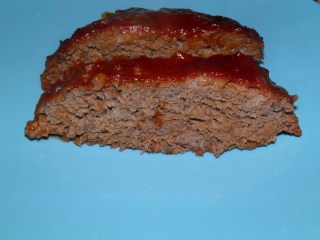
Yes Virginia, There Really is a Good Meatloaf

Let’s get the facts straight right from the beginning … I HATE MEATLOAF! Well, until now! My family loves meat loaf, but never gets it, because I hate it! I finally decided to be nice and make it because I found a recipe that had such great reviews. 

This recipe was so easy to put together. I actually sat at the kitchen table with all of my ingredients and had it together in minutes. It comes out of the oven so juicy, and simply yummy. I have only had meatloaf a few times in the past, and it’s always very dry. You won’t have to worry about that with this recipe! 

One piece of information I will give you is that when you initally put it all together it seems very wet, but this is what keeps  it moist while it’s baking. This got rave reviews in my house … even from me! Original recipe
Serves 4-5
Ingredients:
  • 1 1/2 lbs ground beef 
  • 1 slice bread (broken or chopped finely)
  • 1 egg
  • 1 small vidalia onion or type sweet onion, finely chopped
  • 1 teaspoon table salt
  • 1/4 teaspoon black pepper
  • 4 tablespoons ketchup
  • 1/2-2/3 cup whole milk or half-and-half
Sauce:
  • 4 tablespoons apple cider vinegar
  • 2-4 tablespoons dark brown sugar, packed firm (I used 3 tablespoons I will only use 1 1/2 – 2 next time)
  • 1/2 cup ketchup
Directions:
  1. Meatloaf: Combine meat loaf ingredients and place into a loaf baking dish.
  2. Smooth out top.
  3. Sauce: Combine sauce ingredients and pour on top and sides of meatloaf.
  4. Bake at 350°F about 1 hour to 1 hour 15 minutes or until done

Print Friendly and PDF
Check Out Our Online Recipe Book: www.CafeChatterbox.com

Recipes

We Lost Our Loving Bunny

Yesterday our little bunny Cody went to bunny heaven. His presence is already greatly missed. The cats seem lost without their friend, and the humans are missing him like crazy too.
Who knew cats and rabbits could cohabitate so well together. They loved to play with Cody! He would chase them and they would chase him. I think he had identity crises and thought he was a cat himself. After all he did teach all the cats how to use the litter box, and they taught him how to walk on the tile floor, and roll over the way they did.

He was such a special guy. He was a free range rabbit never caged and always had free roam of the house. He wouldn’t have even known what to do if he had been put outside. He was a happy cat rabbit!
He was part of my life before I met my husband! It’s funny how something so small can be such a big part of your life!!

You are missed terribly Cody Roader! 4/26/04 – 08/03/2011 *big smile … little tear*

Recipes

Taco Salad Redux (287 Calories)


I love taco salad, but it’s easy to see that if I want to keep the calorie count down I have to make a few simple swaps then I can have a large filling salad for less than 300 calories.
Obviously it’s all in what you are willing to sacrifice, but one thing I am starting to realize is I am a creature of habit. I have put my taco salad together the same way each time I have made it, simply put because that’s just the way I have always done it. 
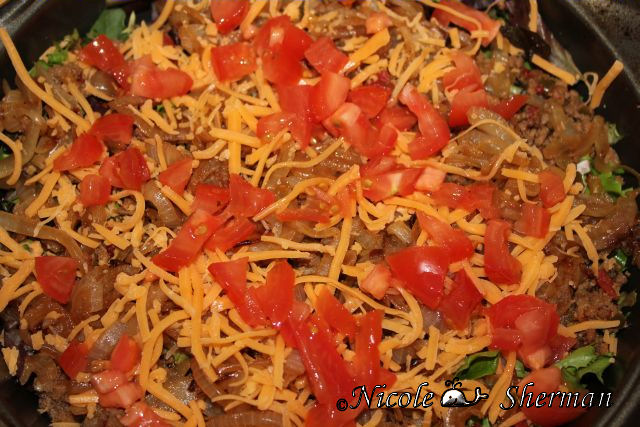
After leaving the items out that drive up the calorie count and making a few substitutes I realized I didn’t even miss the missing items! I enjoyed the taco salad without the high calorie content! I left out the tortilla chips I would normally line the bottom of my taco salad with, and substituted extra lettuce for a true salad. I don’t eat sour cream so I left that out but used fat free sour cream for my husband. I also used fat free cheese verses regular cheese! Talk about saving a ton of calories! I also doubled up on the vegetables to make the salad more filling!
My taco salad would have normally been many calories now it’s calories! That’s a huge redux!
Original Taco Salad:
  • 1/2 cup of taco meat 150 calories
  • 1 cups of Taylor organic greens 3.5 calories
  • 1/2 medium Roma tomato 17.5 calories
  • ¼ Kraft Cheddar Shredded cheese 110 Calories
  • 2Tbs Sour Cream 60 Calories
  • 3 Jumbo Black Olives Sliced 25 Calories
  • 10 Mission Tortilla Chip Yellow Rounds 140 Calories

Total Calories: 506


Taco Salad Redux:
  • 1/2 cup of taco meat 150 calories
  • 2 cups of Taylor organic greens 7 calories
  • 1 medium Roma tomato 35 calories
  • 2Tbs Fat Free Sour Cream 25 Calories
  • 3 Jumbo Black Olives Sliced 25 Calories
  • ¼ Kraft Fat Free Shredded Cheddar cheese 45 Calories

Total Calories: 287


The moral of the recipe redux is a total calorie savings of 219 calories! That’s equivalent to an extra meal or a great snack in calories! Take a look at the recipes you normally cook and you just might be surprised how many calories you can shave off your meal by just making a few substitutes that you won’t even notice!

Recipes

How Accurate Are Restaurant Calorie Counts?


This article caught my eye because anytime I got out for dinner I do some planning ahead of time. Now I always know what I want to eat before I want in the door of a restaurant because I want to know how many calories are in the foods I am eating. I go to the restaurants website before leaving the house for the calorie count. After reading this article it makes me wonder hum… keep reading! Great article!

By Lisa Collier Cool
Americans are eating out more than ever before, but can we trust the calorie counts on restaurant menus? A new study published July 19 in Journal of American Medical Association (JAMA) suggests that these numbers should be taken with a grain of salt, since 40 percent of the foods analyzed had more calories than stated on the menu. 19 percent of the time, the count was off by 100 or more calories, with one belly-busting side dish that contained upwards of 1,000 more calories than claimed on the menu.
While many eateries do have trustworthy calorie counts, the US Department of Agriculture-funded study reported that the surprising rate of undercounts, especially for fattening foods, were hardly likely to be random error and could derail efforts to lose weight.  The researchers tested 269 randomly selected foods purchased at 42 restaurants in three states. Here’s the skinny on the study:

Which restaurants were studied? The researchers tested takeout meals from quick-serve and sit-down eateries within 25 miles of Boston, Massachussetts, Little Rock, Arkansas, and 65 miles of Lafayette, Indiana. All were part of restaurant chains that ranked in the top 400 nationally for sales dollars in 2008 and provided nutritional information on their website. In each region, foods from seven quick-serve and seven sit-down restaurants were analyzed.


Which foods should you watch out for at sit-down restaurants? According to the study, main courses that seem to be better choices for those watching their weight (entrees purporting to have fewer than 600 calories per serving) “systematically contained more energy than stated,” thus impeding efforts to slim down amid a growing obesity epidemic. Sit-down restaurants tended to overstate the number of calories in main courses with more than 600 calories, the researchers found.
Which fast foods are most likely to contain hidden calories? Beware of misleading calorie counts on side dishes at quick-serve restaurants, since the actual calorie counts “were significantly higher than stated,” the researchers reported. The worst offenders were high-carb foods and dressed salads, both of which were much more likely to have incorrect counts that understated calories, compared to sandwiches.
How inaccurate are restaurant calorie counts overall? 60 percent of restaurant counts matched the researchers’ analysis. 40 percent were higher than the stated number by 10 or more calories, but only 19 percent were off by 100 or more calories, indicating that 81 percent of foods tested either had the right count or one that was within 99 calories of the actual count, which is reasonably accurate. However, 10 percent of foods tested averaged 289 calories higher than the number claimed by the restaurant. Bottom line: there is a 1 in 10 chance that your meal may be more fattening than the menu leads you to believe and a 1 in 5 chance that it harbors at least a few hidden calories.

How do restaurant calorie counts stack up to supermarket food labels?

Currently, there are no federal standards to mandate acceptable levels of accuracy for calorie counts in restaurant-purchased foods, while packaged-food regulations require that the measured energy content in a random sample of 12 units must average no more than 120 percent of the stated calorie count on the label.
Which foods were checked in the study? In sit-down restaurants, only entrees and side dishes were analyzed, including pizza, sandwiches, salads, pasta dishes, omelets, ethnic dishes, soups, and meat or fish-based entrees, while all menu items from quick-serve eateries were included, except beverages, self-serve buffets, and kids’ meals. In each case, a serving was deemed the entire amount served, except for pizza, for which a portion was deemed the number of slices defined as a serving by the restaurant.
How were the foods tested? One serving of each food was ordered for takeout, then was analyzed with a bomb calorimetry technique that measures the heat of combustion of freeze-dried foods to determine the energy content.  This method is considered extremely accurate. For the 10 percent of foods that had the greatest discrepancies with the restaurant’s calorie count, another serving was purchased and analyzed, usually with similar results.
Why is the research important? Studies show a strong link between eating out frequently and increased risk for obesity. Misleading calorie counts may compound the problem, since nearly half of Americans consume at least three restaurant meals per week, and 12 percent eat out more than seven times a week. New legislation will soon require many restaurants to provide calorie data. Your best defenses against inaccurate counts are selecting items that don’t contain gravy or dressing, choosing baked or grilled foods over fried, opting for more vegetables and less meat, and eating only half of the food on your plate, since restaurant portions tend to be large.

Recipes

7 Secrets About Store Brands

I found this article practically appealing because I am kind of a cheapo! I can’t help it! There are so many things in this world I would like to have and so many things I would rather spend money on than food! I love buying store brand products if they are good products. I am willing to give them one shot (for the most part) if they are a hit I will keep buying them. Don’t get me wrong there are some things I don’t compromise on unless I can get it for free, but I am pretty adaptable. Read on… Great article!


By Laura Heller, Forbes.com
Store brands—those generic labels we often equate with bargain quality—are among the fastest growing and most popular items for sale today. They provide more choices, help us save money and have come a long way from the bottom-shelf, hokey-labeled products from decades past. But not all store brands are created equal. You may be surprised to learn that an in-house brand isn’t always what it seems.

A typical generic product (also called “private label”) yields a higher profit for the store, even when it sells for a lot less than the similar national brand. That’s because there are no marketing or advertising costs involved and why companies invest a good amount of money in creating private labels. Name-brand consumers pay for those Superbowl ads in the form of higher per item prices.
“Private label provides value and it’s higher margin,” says Natalie Berg, Global Research Director at Planet Retail, a retail intelligence agency in London. “In a down economy, it really ticks two boxes—boosts the bottom line and drives loyalty.”
It’s a common misconception that private label products are just the better known brand with a different coat of paint. Not true. There are dozens of small companies dedicated solely to developing store brands and they work directly with the retailer to develop the item, label and price points. Even when an item is made by a large well-known brand, it’s not exactly the same. If a big brand like Heinz or Hunts decided to sell private label, it will make soup or pasta sauce, not ketchup. Companies want to expand their business, not destroy the existing one.
Perhaps most surprising is the number of house brands in the market that we don’t even know are private label. Take White Cloud, for example. Once a widely available national brand of toilet paper, White Cloud is now sold exclusively at Walmart stores. Rock & Republic, a premium denim line available at luxury retailers likeNeiman Marcus, will soon be a store brand (as of Spring 2012, it will be sold exclusively at Kohl’s).
The bottom line is that store brands will save you money. A recent study from the Private Label Manufacturers Association found that consumers save an average of 33 percent on the total grocery bill by buying store brands. While most of us don’t exclusively buy private label products, increasing the number of store brands in our shopping basket will have a noticeable impact at the cash register. 
Not Just A Cheap Alternative
Store brands are not only the value option, they can be premium and specialty items. Private label organic options and ethnic foods are among the fastest growing product categories, representing value and high quality while offering something unique to the store.
Designer Private Labels
Those “exclusive partnerships” between a famous designer and retail chain are actually new store brands. Simply Vera by Vera Wang at Kohl’s andMichael Graves kitchen accessories at Target are manufactured for, and sold exclusively at those stores.

Rising Above

Sometimes store brands transcend their limited availability and become national brands. Martha Stewart once had products only available at Kmart, but today sells a variety of lines at multiple retail outlets including her own web site. SearsCraftsman tools, Die Hard batteries and Kenmore appliances are store brands with arguably more cache and shopper loyalty than the store that started them. Store brands from Safeway like O Organics and the Eating Right labels are sold at other supermarkets, mostly in markets where Safeway doesn’t have stores.


Inspiring Loyalty

Many shoppers express devotion to store brands above all others. Costco, Trader Joe’s and Aldi, carry a higher proportion of store brands than other chains. And this is exactly why shoppers keep coming back.

Store Brand Camouflage

Using fancy packaging and strategic titling, retailers sometimes make it difficult to spot the store brand. Look at the label to see who the item is distributed by or for. Often the item will have the store’s name or headquarters location–like Target’s in Minneapolis.

Size Doesn’t Matter

It’s not just the big retail chains that carry store brands. All retailers have access to private label options and make sure to stock items in popular categories to remain competitive. Even online retailers are getting into the act. Amazon has the AmazonBasics line of consumer electronics, Denali tools and Pike Street bath and home products.


Inferiority Complex

Store brands aren’t always just junk imported from China. Experts note that most food products are likely sourced domestically while all non-food items come from the same places, regardless of brand. All are subject to federal guidelines and safety standards.